
Passing the ADsP: a working adult's 2-week study plan
I took the ADsP exam to learn to read SAP data with evidence instead of gut feeling. A round-47 passer shares a 2-week study plan for working adults, plus AI-generated mock exams.
Hi, this is Rabbit! 🐰
Working with data, you hear this kind of thing a lot: “This should be fine.” “It’s similar to last month, so it should be okay.” I used to say it too. Whether an on-time delivery rate was at a safe level, whether the variance in production output was within a normal range — even while looking at the numbers, I was ultimately judging by gut feeling built up from experience.
In my last post I wrote about why I went back to school, and choosing to take the ADsP was part of the same thread — a first step toward becoming someone who “reads” data instead of just “looking at” it.
- The ADsP has 3 subjects, 50 questions total; you pass with an average score of 60+ across all subjects and at least 40% in each individual subject.
- The core study method was a quick pass through a condensed theory summary, followed by repeated practice with AI-generated mock exams based on past questions.
- A round-47 passer’s self-made mock exams, based on rounds 45–49, are shared at the bottom of this post.
What kind of exam is the ADsP
ADsP (Advanced Data Analytics Semi-Professional) is a nationally recognized private certification administered by the Korea Data Agency (K-DATA). It tests foundational data analysis skills, has no eligibility restrictions — anyone can take it — and once earned, it’s valid permanently with no expiration.
The exam is a single written test. No practical component. It’s 3 subjects, 50 multiple-choice questions with four options each, 100 minutes, and costs 50,000 KRW to take.
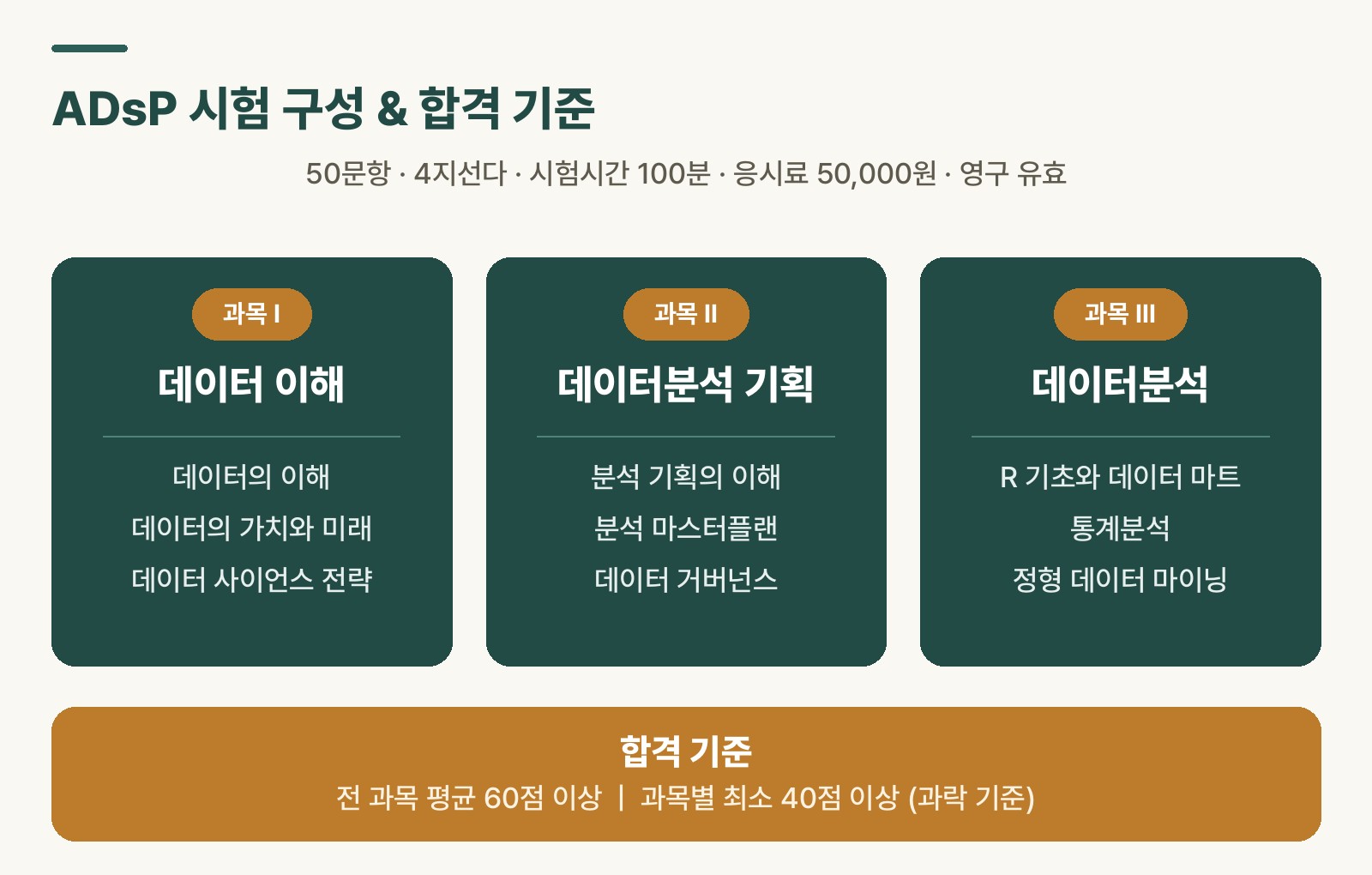 Figure 1. ADsP’s 3-subject structure and passing criteria (per K-DATA)
The subjects break down like this:
- Subject I. Understanding data: data concepts, understanding big data, data science strategy
- Subject II. Data analysis planning: understanding analysis planning, analysis master plans, governance
- Subject III. Data analysis: R basics and data marts, statistical analysis, structured data mining
The passing criterion is an average of 60+ across all subjects, but scoring below 40 in even one subject is an automatic fail. Subjects 1 and 2 tend to feel relatively easy, so quite a few people neglect Subject 3 and fail on that alone.
⚠️ Note: A high score on Subjects 1 and 2 cannot make up for failing Subject 3. Lock in at least 40 points on Subject 3 first, then spend remaining time pushing up your scores on Subjects 1 and 2.
Two weeks, carved out of a working schedule
Total study time was about 2 weeks, roughly 50 hours. There were no big blocks of free time — I filled it in with weekday scraps and weekends.
| Time slot | Duration | How it was used |
|---|---|---|
| Weekday lunch | 30 min | Skimming the theory summary, working past questions |
| Weekday evenings | 1–2 hrs | Mock exams + reviewing wrong answers |
| First weekend | 1pm–6pm | Focused, repeated mock exam practice |
| Final weekend | 1pm–9pm | Drilling frequently missed question types + final review |
Table 1. A working adult’s 2-week study time allocation
The first 3–4 days, I did a quick read-through of a condensed theory summary. I didn’t stop when I hit a concept I didn’t know. A theory summary isn’t for understanding everything — it’s for mapping out which concepts show up on the exam.
Once I finished the read-through, I paired it with summary lecture videos on YouTube. Since I’d already covered the theory, I sped through videos under an hour long, just picking up “oh, so that’s how this concept gets explained.” No need to finish every video start to finish — it’s more efficient to cherry-pick the parts that are hard to grasp from text alone, like the statistics section.
Focused training with AI mock exams
The core of the studying was past exam questions. ADsP’s question patterns repeat reliably from round to round, so getting familiar with the patterns is the fastest path to passing.
Past-question reconstructions I found online turned out to be less accurate than expected — some had wrong answers, some had nonsensical options, some were oversimplified reconstructions. Sometimes it was hard to tell whether I’d gotten a question wrong or the question itself was just broken.
So I changed approach. I fed the online reconstructions to an AI and asked it to build realistic mock exams from them. The AI structured the question patterns and core concepts and generated new combinations of answer choices — not identical to the originals, but close enough to let me repeat the same concepts from different angles.
What worked especially well was tracking wrong answers. I logged which question numbers I missed each round — something like “Round 2: missed 2, 10, 11, 20, 43” — and then asked the AI to identify my recurring weak spots and generate similar questions. The more I repeated this, the more clearly I could see exactly where I kept stumbling.
I focused only on the most recent 5 rounds, 45–49. I figured the more recent the round, the closer it tracks to the actual current exam format, and 5 rounds was plenty of material for repeated practice.
💡 Key point: The real value of AI mock exams is tracking wrong answers. Collecting just the questions you missed and repeating them lets you quickly spot which question types trip you up.
In the final week I drilled only the question types I kept missing, and that was the most efficient use of time by far.
By the time I’m writing this post — after passing round 47 (November 2025) — round 49 questions have already come out, so I’ve put together a new version based on rounds 45–49, shared below. Hope it helps anyone prepping for round 50 (August 2026).
Download ADsP AI mock exam, round 1
Download ADsP AI mock exam, round 2
Download ADsP AI mock exam, round 3
Download ADsP AI mock exam, round 4
Download ADsP AI mock exam, round 5
Based on reconstructions of rounds 45–49, so these may differ from the actual exam questions.
Passing, and a shift in perspective
Studying for the ADsP had an unexpected payoff: it naturally overlapped with the statistics course I’m currently taking.
Concepts that show up on the certification exam — variance, standard deviation, regression analysis, cluster analysis — overlapped with course content, and my depth of understanding changed as a result. The certification built the skeleton of the theory, and the course put flesh on it. That synergy was only possible because I was doing both at the same time.
The way I look at SAP data on the job has shifted a little too. Where I used to look at production output and think “did a lot this month, nice,” now I naturally find myself thinking “how much variance is there against the average, is the daily distribution even.” I haven’t gotten to the point of actually running the analysis yet, but having that instinct show up at all is not a small change.
Rabbit’s Takeaway
The ADsP isn’t a hard exam. But if you walk in unprepared, Subject 3’s statistics section trips up more people than you’d expect.
Here’s what I took away from it: don’t spend your time “understanding” the theory book — spend it getting familiar with the “patterns” of past questions.
I had a similar feeling when I first learned SAP. Don’t try to memorize the manual cover to cover — you learn faster by actually running transactions on the real screen. The ADsP worked the same way. In the end, an exam is just about getting used to “what form the questions take.”
Hope the AI mock exams I shared here help. 😎
Read more