
SAP certification vs. CPIM: why you learn your customer's palate before the recipe
A working PP consultant explains why they recommend CPIM before SAP certification — the difference between the 'How' of running a system and the 'Why' of understanding the process, from a practitioner's perspective.
Hi, this is Rabbit! 🐰
After I posted SAP certification guide: how to actually read the certification menu, I got a lot of questions along the lines of “what else should I study to become an SAP expert?” Today’s answer is one certification that’s deeply connected to SAP: CPIM (Certified in Planning and Inventory Management).
Among people actually working in SAP PP (Production Planning), it’s often recommended even more strongly than SAP certification itself. I have a personal story behind why I say this.
- CPIM is an international certification that covers the process and principles of supply chain management, not any specific system.
- If SAP certification teaches “How” — how to implement — CPIM teaches “Why” — why you should do it that way.
- It’s a real investment of time and money, but it broadens a practitioner’s view from the system to the business.
“You’ve got the order backwards”
This goes back to when I first joined an SAP PP implementation project and was struggling to keep up. As the project neared its end, I decided, “Now that I know the system, I should get my SAP PP certification.”
So I asked a veteran PP consultant leading the project, someone with 25 years of experience, for advice. “I want to grow into an SAP expert too — should I start by studying for the PP certification?” I expected a simple “good idea.” What I got instead surprised me.
He was blunt. “You’ve got the order backwards. SAP is just the ‘tool’ that happened to win the ERP market. Memorizing T-codes and matching config values — you can pick that up fast. But if you don’t understand why S&OP (Sales and Operations Planning) has to flow into the MPS (Master Production Schedule), or why the MRP logic unfolds the way it does, you’re not an expert — you’re just an operator pushing buttons. Study CPIM before SAP certification.”
Today I want to unpack why he recommended that.
CPIM vs. SAP certification: the difference between ‘Why’ and ‘How’
The core difference between the two certifications is focus.
- SAP certification focuses on application functionality. It covers how to configure and implement a specific system — SAP.
- CPIM focuses on business process. Regardless of the system, it covers why a given process needs to exist — the global standards and principles of supply chain management.
The key is that CPIM is vendor-neutral. That knowledge applies to any ERP you encounter — SAP, Oracle, Dynamics, whatever — because it’s about fundamental principles. SAP certification, by contrast, is system knowledge that only holds up inside the SAP ecosystem.
Put it in kitchen terms: SAP certification is “how to use this particular kitchen’s oven.” CPIM is “the principles of cooking.” Learn to use one oven, and you have to relearn it in a different kitchen. Learn the principles of cooking, and they travel with you to any kitchen.
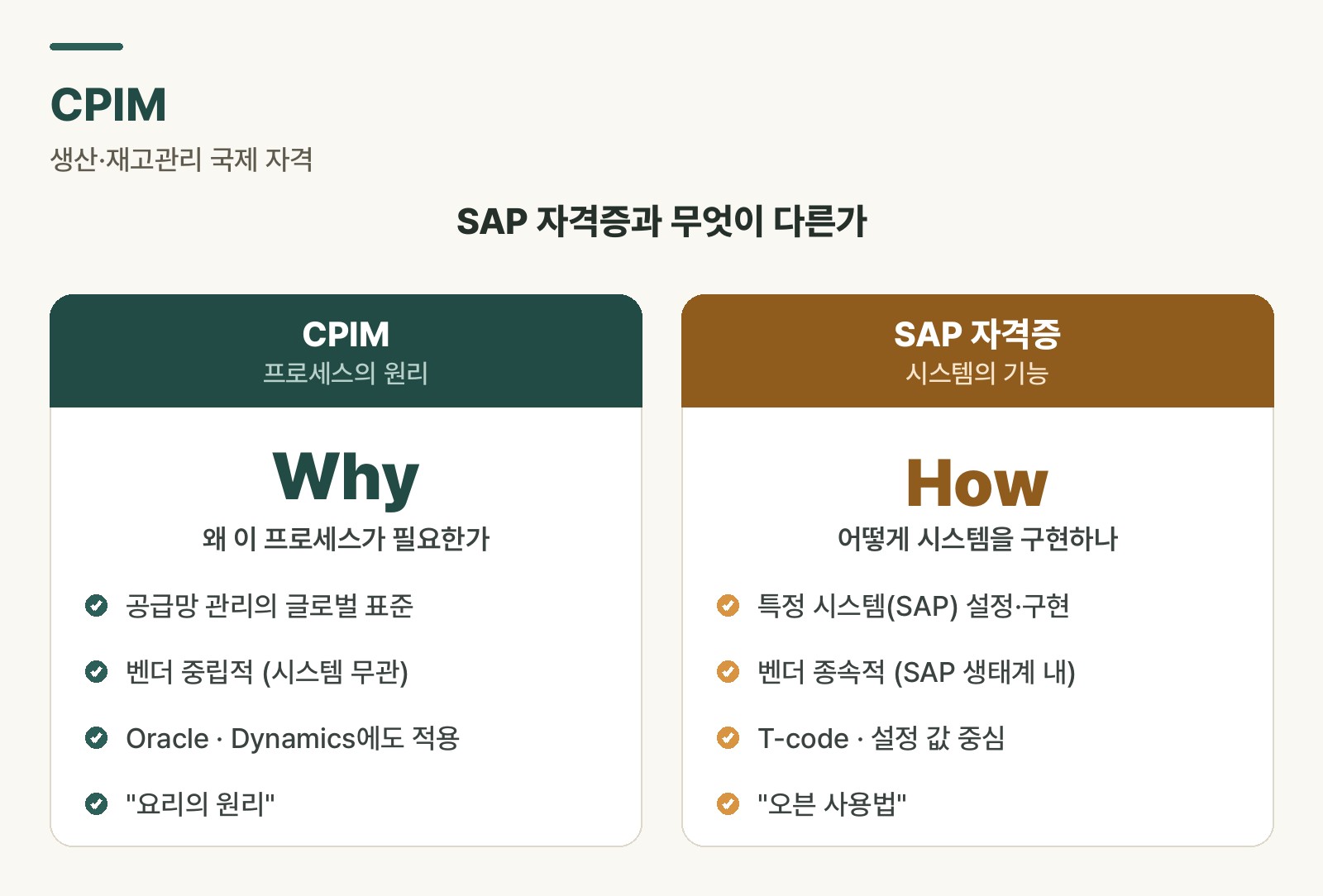 Figure 1. CPIM teaches the process’s ‘Why’; SAP certification teaches the system’s ‘How’
Why ‘principles’ build trust
The real reason that consultant emphasized CPIM comes down to credibility. At its core, an ERP consultant is a translator — converting the customer’s business needs (reality) into system logic (SAP). CPIM knowledge is what determines the quality of that translation.
Say a production manager tells you, “Because of a bottleneck at Machine A, we need to manually adjust the weekly plan.”
A consultant who only knows How says, “SAP’s standard logic assumes infinite capacity, so that’s difficult. Just follow the standard process.” The customer walks away thinking, “IT doesn’t understand how our floor actually works.”
A consultant who knows Why responds differently. “That machine is a capacity-constrained resource (CCR). In that case, we need finite capacity scheduling. We can use PP/DS functionality, or get a similar effect by adjusting the MRP logic and lot sizing within the standard system.” Only then does the customer feel, “This person actually understands our problem.”
Trust doesn’t come from appearing to know a lot — it comes from the ability to reframe a customer’s complicated problem in standard language and show you understand it. CPIM is, in effect, that shared language of understanding.
What CPIM actually covers
CPIM is an international certification in supply chain and inventory management administered by ASCM. A single comprehensive exam covers 8 modules, and the way they’re organized lines up strikingly well with SAP’s core modules.
Supply chain strategy, S&OP, demand, supply, detailed scheduling, inventory, distribution, and quality/continuous improvement — these eight areas are essentially the logical flow of how a company’s SCM operations actually work. Each one corresponds to the “reason for existing” behind SAP’s PP, MM, SD, and QM modules. Learning CPIM means understanding why SAP’s modules are designed the way they are.
Cost and renewal: not a small investment
The most practical barrier is time and money. As of 2026, here’s the breakdown.
It’s a single comprehensive exam: 150 questions in about 3.5 hours, with a passing score of 300. Preparation typically takes 3–6 months of focused study. The bundle — including the learning system, exam voucher, and a retake — runs about 2,230 USD (for ASCM members; higher for non-members). Through an official partner in Korea, that’s roughly 3.2–3.5 million KRW.
⚠️ Note: CPIM is being revised in 2026. The new bundle goes on sale starting February 2026, and the revised exam becomes available from June 1 (the current exam ends May 31). If you’re planning to take it, check which version applies to you.
And it’s not a one-and-done credential. You need to earn 75 professional development points (CEUs) every 5 years to renew it, and if you miss the window, your certification expires and you have to retest. Similar to SAP certification’s annual renewal, CPIM is also a “certification you maintain.”
Rabbit’s Takeaway
CPIM isn’t an “alternative” to SAP certification. It’s closer to a multiplier that accelerates an SAP professional’s career. If SAP teaches “how to implement,” CPIM teaches “why you should implement it that way.”
This is exactly what this blog keeps coming back to: process and workflow matter more than code. If you want to use SAP not as a mere button-pusher but as a practitioner who understands the business, CPIM is worth seriously considering.
Honestly, I plan to take it on myself someday. But given the time and money required, I want to wait until I can commit fully and approach it carefully. When I do take the plunge, I’ll document that journey here too. 😎
Read more